In a hypothetical comparison, two prototypes start at pH 5.2. An ingredient addition shifts one reading more than the other. To investigate the difference, check their buffer capacity as well as the measurement method.
pH describes the starting condition. Buffer capacity describes resistance to a change in that condition.
What the pH reading describes
pH expresses hydrogen ion activity on a logarithmic scale in an aqueous environment. One pH unit represents a tenfold change in that activity. The reading does not measure the sample’s total acidic material or identify the acids present.
Check the measurement conditions when comparing the prototypes, especially sample preparation and temperature.
Buffer capacity concerns resistance to change
A buffer resists pH change when acid or base is added. Its capacity concerns the amount it can accommodate over a specified pH interval.
For a simple weak acid and conjugate-base pair, the Henderson–Hasselbalch relationship links pH to their ratio within the approximation’s limits. Two solutions can have a similar ratio and pH but different total concentrations of the pair. The more concentrated system generally has more material available to respond to an addition. This explains the distinction; it does not predict every cosmetic mixture.
If that resistance matters to a development question, use a defined titration. Specify sample preparation, temperature, titrant, and pH interval so the comparison has a clear meaning.
Attach a method to the number
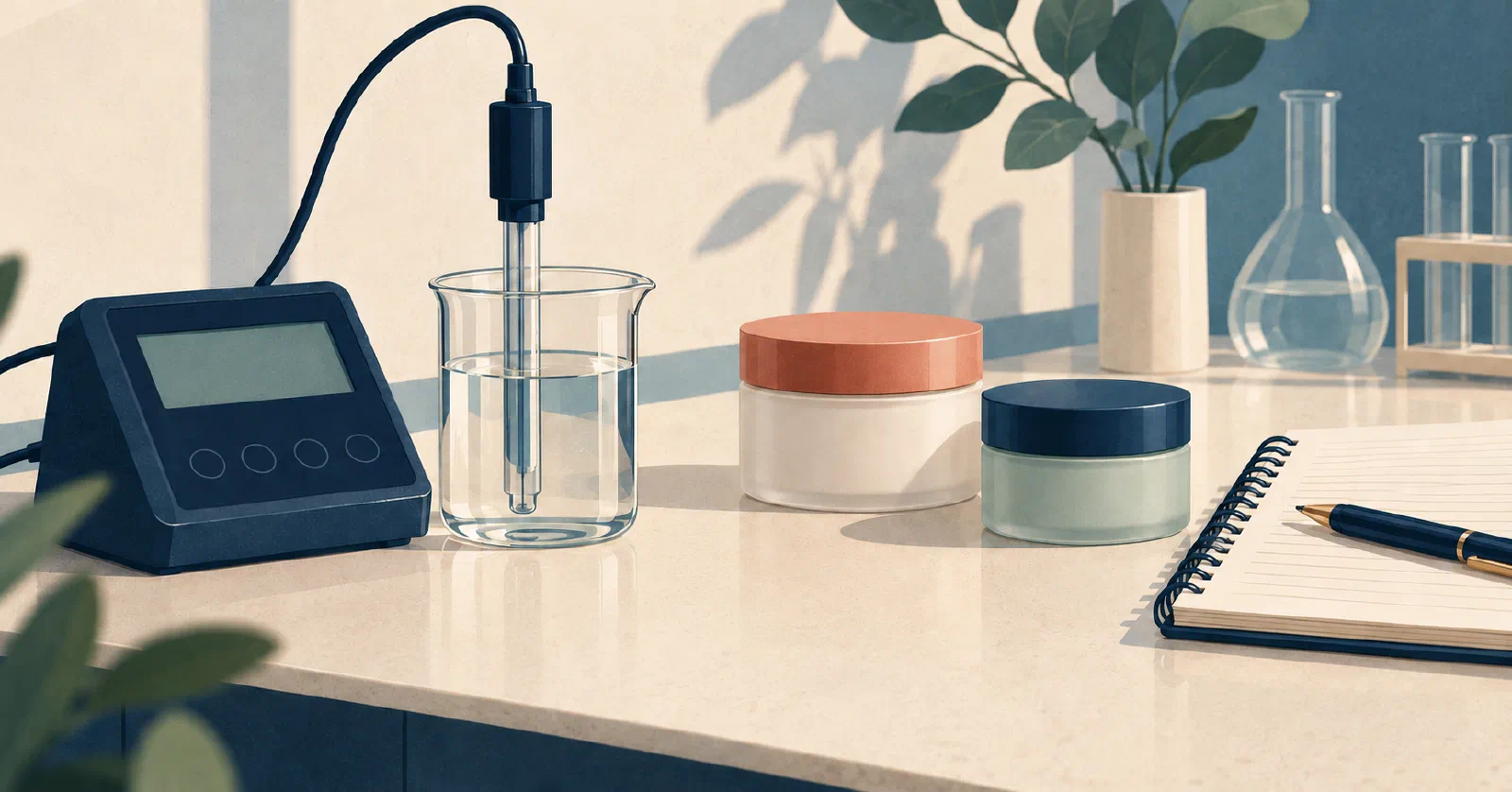
Record whether the product was measured directly or after preparation, along with electrode, temperature, and settling conditions. A diluted measurement should not silently replace a direct one in the history.
Use suitable calibration buffers around the expected range and follow the instrument and electrode instructions. Avoid contamination and reuse of calibration portions where prohibited by the method. Before changing the formula in response to an unexpected result, repeat the measurement under the established conditions and check the equipment.
Preservation needs its own evidence
pH affects the balance between ionised and nonionised forms of a weak acid. That chemical relationship does not, by itself, establish antimicrobial performance in a formula.
Research on benzoic and sorbic acids in oil-and-water food model systems found distribution changes with pH and the aqueous medium. Its relevance here is the distribution between phases; cosmetic use levels require evidence for the proposed use. Separate topical formulation research evaluated preservative combinations through challenge testing. Use appropriate preservation testing and microbiological risk assessment for the actual product.
Investigate a shift before adjusting the formula
Set and justify the pH range, then decide which work is needed near its limits. Review pH with the other selected observations, such as appearance, rheology, relevant assays, and microbiology. An unchanged reading does not measure those properties.
If a reading shifts, check the measurement method and sample history before adding neutraliser. Record the original value and investigate the cause, even if an adjustment later brings the sample into range.
Sources
- IUPAC Gold Book: pH.
- IUPAC Gold Book: Henderson Hasselbalch equation.
- Fisher Scientific: pH 510 and Ion 510 instruction manual, hosted by NIST.
- Cheng, Friis and Leth: Partition of selected food preservatives in fish oil water systems.
- Rahali and colleagues: Optimization of preservatives in a topical formulation using experimental design.